 Buxtehude Database
Dieterich Buxtehude
c.1637–1707, day by day: a free, sourced, non-commercial database of his BuxWV works, surviving manuscripts and early prints, copyists, dated life, and open findings.
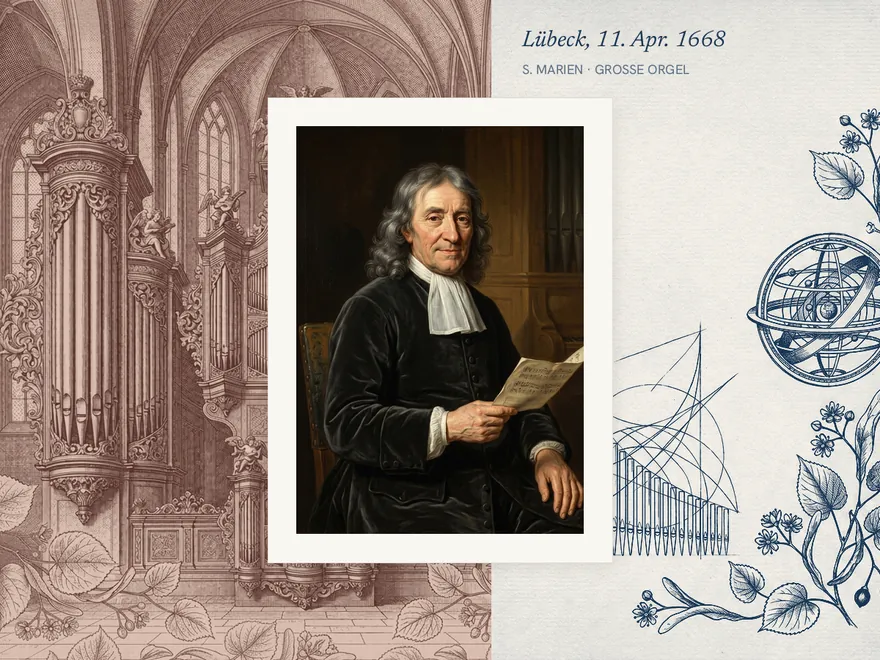
Every row carries its source URL, licence, and retrieval date. Dates are copied strictly as each source states them — no Julian/Gregorian conversion and no invented days. Full machine-readable data at /api and /llms.txt.
Helsingborg / Oldesloe
- c.1637 Family Birth of Dieterich Buxtehude (c.1637; exact date and birthplace unrecorded; his 1707 obituary in Nova literaria maris Balthici gives his age as about 70 and notes that he regarded Denmark as his fatherland). Most scholars place his birth in Helsingborg (then in Danish Scania) or Oldesloe (Holstein). source · CC0-1.0 (Wikidata)
- 1641 Family Dieterich's father, Johannes (Hans Jensen) Buxtehude, is documented as organist in Helsingborg (then Denmark) by an inscription he made on a relocated organ; by 1642 he moved to St Olaf's Church (Sankt Olai Kirke) in Helsingør, where he served for 32 years. source · CC-BY-SA-4.0
Helsingborg
- 1657–1660 Office Serves as organist at St Mary's Church (Mariakyrkan) in Helsingborg (first named in church accounts in 1658; retroactive payment indicates tenure from 1657 until 1658 or 1660). source · CC-BY-SA-4.0
Helsingør
- October 1660 Office Appointed organist of the German congregation at St Mary's Church (Sankt Mariæ Kirke) in Helsingør, Denmark, serving until April 1668. source · CC0-1.0 (Wikidata)
- 1662–1666 Records Church records at St Mary's, Helsingør document Buxtehude standing as godfather for the son of the German cantor and participating in the German-speaking parish community while his family also corresponded in Danish. source · CC-BY-SA-4.0
- November 1667 Office Following the death of Franz Tunder on 5 November 1667, the church council of St Mary's Church (Marienkirche) in Lübeck holds auditions to select a successor as organist and Werkmeister. source · CC-BY-SA-4.0
Lübeck
- Office Appointed organist and Werkmeister (church treasurer and administrator) of St Mary's Church (Marienkirche), Lübeck, succeeding Franz Tunder. The church housed two organs: the Great Organ (Große Orgel) for main services and the Totentanz organ for smaller services and funerals. source · CC0-1.0 (Wikidata)
- Family Marries Anna Margaretha Tunder, daughter of his predecessor Franz Tunder, in Lübeck; the couple had seven daughters, four of whom survived to adulthood. source · CC0-1.0 (Wikidata)
- 1669 Office At Buxtehude's initiative, additional musicians' galleries are constructed in Marienkirche, Lübeck to accommodate vocalists and instrumentalists alongside the organ during evening concerts. source · CC-BY-SA-4.0
- 1671 Works Composes the contrapuntal mourning cycle Mit Fried und Freud ich fahr dahin (BuxWV 76a) in honour of Menno Hanneken; later paired with the Klag-Lied (BuxWV 76b) and printed in 1674 as Fried- und Freudenreiche Hinfarth (BuxWV 76) on his father's death. source · CC-BY-SA-4.0
- 1673 Family After retiring as organist of St Olaf's Church in Helsingør, Buxtehude's father Johannes joins the family in Lübeck (where he dies on 22 January 1674). source · CC-BY-SA-4.0
- 1673 Office Reorganizes the Lübeck evening concert series begun under Franz Tunder into the annual five-Sunday Abendmusiken (two last Sundays of Trinity and the second, third, and fourth Sundays of Advent), funded by Lübeck merchants and open free to the public. source · CC-BY-SA-4.0
- 1674 Records Johannes Voorhout paints Domestic Music Scene (Hamburg, 1674), depicting Johann Adam Reincken at the harpsichord with a viola da gamba player widely identified as Buxtehude holding a canon inscribed in honour of Reincken and Johann Theile. source · CC-BY-SA-4.0
- 1677 Family Dieterich's brother Peter Buxtehude, a barber-surgeon, joins the household in Lübeck. source · CC-BY-SA-4.0
- 1679 Office Johann Jacob Pagendarm takes office as cantor in Lübeck (succeeding Samuel Franck), serving alongside Buxtehude at Marienkirche. source · CC-BY-SA-4.0
- 1680 Works Dedicates the seven-cantata Passion cycle Membra Jesu nostri (BuxWV 75) to Gustav Düben, Kapellmeister at the Swedish royal court in Stockholm; Buxtehude's close ties with the Düben family account for the survival of over a hundred vocal manuscripts in the Uppsala Düben Collection (S-Uu). source · CC-BY-SA-4.0
- 1682 Records The Marienkirche Abendmusiken attract crowds so large that from 1682 the Lübeck city guard is stationed to maintain order during performances. source · CC-BY-SA-4.0
- 1687 Office Travels to Hamburg to inspect Arp Schnitger's newly completed organ at St Nikolai; continues to advocate for repairs and improvements to the Marienkirche organs in Lübeck. source · CC-BY-SA-4.0
- 1694–1696 Works Publishes two collections of seven trio sonatas for violin, viola da gamba, and harpsichord continuo (Op. 1, BuxWV 252–258, c.1694; Op. 2, BuxWV 259–265, 1696) — his only chamber works printed in his lifetime. source · CC-BY-SA-4.0
- 1695 Records A 1695 music-sale catalogue records titles of vocal and instrumental works by Buxtehude and his contemporaries that no longer survive. source · CC-BY-SA-4.0
- August 1703 Office George Frideric Handel and Johann Mattheson travel from Hamburg to Lübeck to hear Buxtehude and inspect the Marienkirche post, but both decline the customary expectation that his successor marry his eldest daughter Anna Margareta. source · CC-BY-SA-4.0
- October 1705–January 1706 Office In October 1705, the twenty-year-old Johann Sebastian Bach walks over 400 kilometres (250 miles) from Arnstadt to Lübeck on four weeks' leave to hear Buxtehude's organ playing and the extraordinary December 1705 Abendmusiken (Castrum Doloris, BuxWV 134, and Templum Honoris, BuxWV 135), staying nearly four months until early 1706. source · CC-BY-SA-4.0
- Family Death of Dieterich Buxtehude in Lübeck after 39 years as organist and Werkmeister of Marienkirche; he is buried in Marienkirche beside his father and daughters. Johann Christian Schieferdecker succeeds him later that year. source · CC0-1.0 (Wikidata)
Sources & notes
Built from openly licensed musicological catalogues (RISM CC BY 3.0, Wikidata CC0, Uppsala Düben Collection factual metadata). Every row links directly to its primary source.
Cite this page
Ethan Blackburn, “Buxtehude Database: Dieterich Buxtehude (c.1637–1707)”, Buxtehude Database, https://buxtehudedatabase.com/ (data version 2026-11-23+4d194ddf17; accessed [date]).
Cite the original source named in each row first; cite this page for the compilation. Replace [date] with the day you read the page. More on citing and reusing the data.
BibTeX
@misc{buxtehudedatabase-home,
  author = {Blackburn, Ethan},
  title = {{Buxtehude Database: Dieterich Buxtehude (c.1637–1707)}},
  howpublished = {\url{https://buxtehudedatabase.com/}},
  organization = {Buxtehude Database},
  year = {2026},
  note = {Data version 2026-11-23+4d194ddf17; accessed [date]}
}
CSL-JSON
{"id": "buxtehudedatabase-home", "type": "webpage", "title": "Buxtehude Database: Dieterich Buxtehude (c.1637–1707)", "author": [{"family": "Blackburn", "given": "Ethan"}], "container-title": "Buxtehude Database", "URL": "https://buxtehudedatabase.com/", "issued": {"date-parts": [[2026, 11, 23]]}, "version": "2026-11-23+4d194ddf17"}